
NOTE: Scripture references have been selected from both the King James Bible and the Jerusalem Bible.
People of all times and religious cultures have been in awe of holy men and women. Their very presence radiates light and inspiration; they manifest powers over nature; they practice healing; their teachings show the way for individual devotion and spiritual development. Christians honor Jesus as the leader of their faith in this way. It is appropriate to ask, then, how he fits into the larger spiritual tradition. This is a vital question to ask, as many of other traditions honor him as well. This involves terms and designations beyond those of Judeo-Christianity. Three Sanskrit terms in particular, Guru, Siddha,andAvatar, will be examined here. But before beginning a comparative study it is important to establish a firm framework in the Biblical narrative as to who the Bible (and Jesus) says he was.
To begin, there is the Christ of prophecy. The strand of Messianic hope runs through the Old Testament scriptures, and is reflected upon in the new. Rev. Milton Gabrielson, in a long-ago sermon, went so far as to enumerate 456 pronouncements, as he writes, “the details of his existence, along with many other pronouncements from all over the world.” I have no documentation, only this summary, and leave it to you if you wish to pursue this further.
Another window through which this may be viewed is his place in the Davidic dynasty. This prophecy is important because it is both a spiritual and a blood relationship. Much has already appeared in the post, The Root of David and the Branch, a Shoot from the Stump of Jesse. It may be said to begin in Psalms 132:11: “The Lord hath sworn in truth unto David; he will not turn from it; Of the fruit of thy body will I set upon thy throne.” [Jerusalem Bible “Your own son will succeed you on the throne.”] There are two recorded lineages, one in Matthew and one in Luke. This relationship was well-known by the people of Jesus’ time, culminating with the shouts of the crowd on Palm Sunday as they chanted “Hosannah to the son of David”. Joseph, too, was a son of David, and is addressed as such by the angel in the announcement of Jesus’ coming birth. During Jesus’ ministry, those in need of healing such as the blind men implored, “Have mercy on us, O Lord, thou son of David.” The hearers of his message in Matthew 12:23 asked, “Can this be the Son of David?” The affirmation appears in Revelation 22:16, for he is “the root and offspring of David, and the bright and morning star”.
Jesus’ mysterious origin is addressed in John 1:1-4: “the Word of God and his wisdom, before the world was created”, as the Jerusalem Bible notes read, “present with God before the world was made….The incarnation enabled …John to see this separately and eternally existent Word-Wisdom as a person.” We read further, in John 1:18: “the only-begotten Son, which is in the bosom of the Father, he hath declared him.”. In these scriptures we peer into the very heart of the universe, the Ground of Being, which is then manifested in Divine Personhood. Jesus’ mystic utterance in John 8:58, “Before Abraham was, I am.” This is not an error in tense; “I Am” mirrors God’s self-revelation to Moses on Sinai when he enquires as to God’s name, in Exodus 3:14: “ And God said unto Moses, I Am That I Am: and he said, Thus shalt thou say unto the children of Israel, I Am hath sent me unto you.” An entire study could be made on “I Am”, but not here. This assertion carries on into the New Testament and the teaching of Jesus. He is one with the Father, but “took on him the seed of Abraham” (Hebrews 2:15) as the logical progression from the pre-incarnate to incarnation. Jesus tells us in John 8:24: “If you do not believe that I am He you will die in your sins.” It may seem an audacious statement to read in John 14:6: “ I am the way, the truth, and the life: no man cometh unto the Father, but by me”, but this is a serious command, and we must take it as such.
An interesting paradox occurs in Matthew 22:41-46. Christ, the Word, beyond time, is nevertheless the flesh and blood descendent of David :“While the Pharisees were gathered together, Jesus asked them,Saying, What think ye of Christ? whose son is he? They say unto him, The son of David. He saith unto them, How then doth David in spirit call him Lord, saying, The Lord said unto my Lord, Sit thou on my right hand, till I make thine enemies thy footstool? If David then call him Lord, how is he his son?” This stops the questioners in their tracks. “And from that day no one dared ask him any further questions.” Jerusalem Bible notes suggest that the appropriate answer would have been that, “tracing his origins back to David, there would be something about the Messiah to set him above David.”
It is right that we wrestle with both the genealogical and the spiritual aspects of Jesus to gain a fuller understanding. Jerusalem Bible notes to Matthew 4:3 (“And when the tempter came to him, he said, If thou be the Son of God, command that these stones be made bread.”) aid our understanding: They state, “The biblical title ‘Son of God’ does not necessarily mean natural sonship but may imply a sonship which is merely adoptive, i.e. which as a result of God’s deliberate choice sets up a very intimate relationship between God and his creature.” This is confirmed by the sentence at the baptism (Mt 3:17), and also at the Transfiguration (17:5). The scriptural record presents Jesus as having God for his ‘Father” “in a way that others had not” and
“enjoying with the Father an altogether singular relationship of knowledge and love.” Despite the facts that the disciples, at least at the outset, “had no clear conception of his divinity”, Jesus nevertheless “expressed with his own lips, and with as much clarity as his audience could support, his own consciousness of being Son of the Father in the fullest sense.” Further, this reality was manifested in “healings (physical), exorcisms, resurrections, walking on water, calming the storm, and the multiplication of loaves and fishes.”
We have, too, the eternal priesthood of Jesus, following that of the mysterious Melchizedek, who appeared to Abraham and is again mentioned in Psalms 110:3: “Thou art a priest for ever after the order of Melchizedek.” This designation is given from God, and not taken upon himself. It is a priesthood which is unchanging. Referencing the Davidic lineage, it is he, in Revelation 3:7, “who hath the key of David.”
The abundance of Son references establishes Jesus’ spiritual position. These Christological titles appear as the scriptures were later recorded: “You are my Son, today I have become your Father” (spoken by God at Jesus’ baptism), “Son of the highest”, “the chosen one of God”, “Son of the most high God”, “the Savior of the world”, and, spoken by the centurion after seeing the earthquake which followed the crucifixion, “Truly this man was the Son of God.” We are told that he preferred the humble appellation “Son of man”, as in Matthew 8:20: “The foxes have holes, and the birds of the air have nests; but the Son of man hath not where to lay his head.” A motif in the Gospel of Mark, “the Messianic Secret” implies that Jesus purposely hid his identity as the Messiah during his lifetime, admonishing disciples, demons, and witnesses alike not to say anything.
Jesus’ assertion, “I and my Father are one” (John 10:30) is not so radical as it may seem. Oneness with God is a common theme of other traditions as well. There is beautiful, intimate relationship is explained in John 5:19-20: “Then answered Jesus and said unto them, Verily, verily, I say unto you, The Son can do nothing of himself, but what he seeth the Father do: for what things soever he doeth, these also doeth the Son likewise. For the Father loveth the Son, and sheweth him all things that himself doeth: and he will shew him greater works than these, that ye may marvel.” The Jerusalem Bible heading to Matthew 11:27 reads “the reciprocal knowledge of Father and Son”. Here the real source of his power is revealed: there is no division, no confusion, no alteration. Divinity in its essence lies in his Divine Personhood.
The world has not seen the last of Jesus. A hint as to his future appearance is given us in both Matthew 26:64 and Mark 14:62: “ye shall see the Son of man sitting on the right hand of power, and coming in the clouds of heaven.”, also in Revelation 1:7, “behold, he cometh with clouds”, and “the white cloud” of Revelation 14:14. There is a fascinating tie-in. Mormon accounts of Jesus’ appearance in North America correspond to the vision of Wovoka, the patriarch of the Paiutes. Wovoka taught that Jesus is actually upon the earth, and that he moves as in a cloud. Paul Bailey, in Wovoka, the Indian Messiah writes of his vision, where he laid as if dead for several days: “For one solemn hour Wovoka, with tears streaming down his face, expounded the wonders of his vision. He had been in heaven. In a mystic land of great beauty, in which all the once-savage elements had been subdued and glorified, he had walked and talked with the spirits of the departed. There he saw the savagery of the wild beast reduced to the tranquility of lambs at play [“the wolf shall also dwell with the lamb”]….He saw the flowering of physical beauty, an end of all pain and disease, and man’s final victory over death.” [“O death, where is thy sting?”]. He showed his followers the Ghost Dance. This is “a dance of goodness which has come from heaven and will make people free and glad”. In 1890 a great number of white Mormons danced the Ghost Dance with the Indians. This was prophesied by Joseph Smith in his Doctrine and Covenants, where he hears a voice saying, “Joseph, my son, if thou livest until thou art eighty-five years old, thou shalt see the face of the Son of Man”. Had he lived to that age, this would have been the year 1890. Wovoka’s vision occurred in 1889.
I leave you with one final image, an important one for Christians. It is Jesus as the stone (or rock), in hymnology: “On Christ the solid rock I stand, all other ground is sinking sand”, “Rock of ages, cleft for me”, “How firm a foundation, ye saints of the Lord”, etc. Early Christian teaching quotes Psalms 118:22: “The stone rejected by the builders that proved to be the key stone”. It (he) is “a stumbling stone and a rock of offence” in Romans 9:31 and “the stone rejected by the builders”; in Acts 4:10-12: “This is the stone which was set at nought of you builders, which is become the head of the corner. Neither is there salvation in any other: for there is none other name under heaven given among men, whereby we must be saved.” 1 Corinthians 3:11 concludes, “For other foundation can no man lay than that is laid, which is Jesus Christ.”. The wineskins of the Judaic tradition were no longer sufficient to hold the person and spiritual power of Jesus—it is imperative that, to fulfill his nature, he needed to move beyond the confines of Judaism alone to become the Savior of the world. It is his mission, his destiny. The Good News is that he must include his “other sheep”—all sheep, without condition. It is this which opens up our consideration to the wider spiritual tradition.
The appearance, work, and destiny of Jesus as spiritual master did not occur in a vacuum. It is important to show that the manifestation of Jesus falls squarely within the nature of those of other traditions. He is universal. Did he not say in John 10:16, “Other sheep I have that are not in this fold [of Judaism], and these I have to lead as well. They too will listen to my voice, and there will be only one flock, and one shepherd.” The universal gathering of devotees is also stated in Matthew 8:11: “And I say unto you, that many shall come from the east and west, and shall sit down with Abraham, and Isaac, and Jacob, in the kingdom of heaven.”
There can be only one spiritual reality, though revealed differently. Jesus as Messiahis part of the long history of Divine Personhood attempting to break into the world. The opening chapter of the Gospel of John, describing him as the Word, is a most satisfying presentation of his place in, and beyond, history. We take nothing away from Jesus by placing him in the context of those who have brought life, light and spiritual deliverance to the struggling beings on earth.
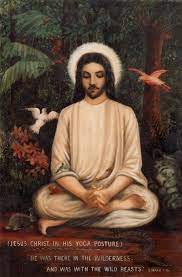
Jesus lived and worked in the great tradition of Abraham, who proclaimed the radical truth that God was One, not Many He must have foreseen the difficulties of communicating his vision, for he spoke to the disciples at length not only on his oneness with God, but on the oneness of his followers with him. At this point the question must be asked: Does the line of prophets, teachers, and healers of all religious traditions stretch on through history in a continuation of the revelation of divine truth? Several Hindu teachers have venerated Jesus in this way and have claimed to have seen visions of him in their meditation. If so, may the power of Jesus then be described in terms of guru, siddha, or avatar?
We should rightly be wary of gurus. There are many charlatans, and the potential is great for deception. The etymology of the word, as explained by John Grimes in his Sanskrit Dictionary, is “a composite of two contrasting words meaning ‘darkness’ and ‘light’, gu andru, indicating remove + darkness. Therefore, the true gurufunctions to release, turn, point, or lead living beings from darkness (non-Truth) into light (very Truth). Supporting this is the Gospel of John, which could well be called a gospel of light. The Word (existing with God before the incarnation) was the true light (1:9); John the Baptist himself was not the light, but a precursor, a witness to speak for the light (1:7); people prefer darkness, although the light has come into the world (3:19); “I am the light of the world; anyone who follows me will not be walking in the dark; he will have the light of life.” (8:12); Jesus tells his disciples that the light will only be with them a little longer and to walk while they still have the light (12:35); and concluding “whoever believes in me need not stay in darkness anymore” (12:36).
Devotees relate to the Spiritual Master through intense devotion, or bhakti. We need only to see the intense veneration with which Latin American Christians hold the Virgin of Guadalupe (in addition to that of Jesus and Mary) as an example. A related quality associated with bhakti, is that of enthusiasm. Many of us have felt this emotion when the spiritual fire catches hold of us. Jesus himself addressed this. The Jerusalem Bible heading to Luke 14:34-35 (parallels in Matthew 5:13 and Mark 9:50) is “On loss of enthusiasm in a disciple”. The metaphor used to describe this is salt which, if it has lost is savor, wherewith shall it be seasoned? In Matthew 5:13: “Ye are the salt of the earth: but if the salt have lost his savour, wherewith shall it be salted? it is thenceforth good for nothing, but to be cast out, and to be trodden under foot of men.” Anything which has lost its usefulness is a sad thing indeed—how much more the joy and conviction which once inhabited the devotee in the early days is his/her conversion. Like a precious treasure, it must be guarded, encouraged, and never lost.
Next, I would like to direct your attention to the termsiddha. Again, citing John Grimes, it comes from the verb rood sidh=”to attain”: complete, perfect, accomplished, adept, a perfected being, an accomplished one, a seer, a perfected yogi. one who has attained the highest state and become one with God.” Siddhasare also those powers manifested by these beings in the temporal world. Turning to Jesus and the biblical record, we have water turned into wine, the multiplicated of loaves and fishes, casting out of demons, healing of infirmities, walking on water, calming the storm, knowing the thoughts and motives of others (Matthew 9:4: “and knowing their thoughts”), resurrections from the dead, and, ultimately, his own resurrection, ascension, and post-resurrection appearances (an amazing number of which continue to this day). We stand in awe of them all. Yet, as he has taught, faith in these powers is not what is required, only faith in him alone.
The true guru is the Siddhi-Guru, a perfect Master, one who functions as gurufor
others, who is himself the very Truth that is awakened in the devotee. Here, Guru is also the Divine Person, Purusha, and has a vital role. The Upanishads state, “He who burned out all sins before all—everyone—is Purusha.” [in Hume’s translation “Since before (purva) all this world he burned up (root us) all evils, therefore he is a person (pur-us-a) According to this, the derivation of the word Purusha is from purvam (before or being in front of) and osah(burning): The Man burns out sin.” The Kaushitaki Upanisad (2:7) contains the notion of the Purusha as the “snatcher of sin”.
Is this not the “Lamb of God, who taketh away the sins of the world” (John 1:29)? Dealing with sin and its effects on our consciousness is a persistent theme which crosses religious traditions. The color amber, which attracts many by its spiritual quality, is included in the following selection from Phillip H. Wiebe’s numerous accounts post-resurrection appearances of Jesus in his books Visions of Jesus and Visions and Appearances of Jesus. One of his interviewees, an employee in a convenience store, was serving coffee to his customers when one in front of him was suddenly transformed to a vision of Jesus. Suddenly, as Wiebe writes, he “lost all sense of heaviness, and felt as though he was floating away into an amber light. The euphoria that accompanied the experience was like being drunk. He took hold of himself in order to do his work, but the experience left him changed. All feelings of guilt and inadequacy mysteriously left him. It was only later in the day, when listening to a Christian program about Jesus Christ’s taking away sin and guilt, that [he] put this interpretation on the event that had transpired.” (More of Wiebe’s accounts appear in the post I Just Want to See His Face.)
But how is sin removed? We are given a clue in the writings of Adi Da Samraj (Frankin Jones) in his book The Method of the Siddhas: talks with Franklin Jones on the spiritual technique of the saviors of mankind: “For years I would sit down in meditation and all my own forms would appear, my own mind, my desires, my experience, my suffering, my feeling, my shakti[spiritual energy], my this and my that. But at some point, it all came to an end. There was nothing, nothing there anymore, none of that distracted or interested me. Meditation was perfect, continuous. Then I began to meet those friends who first became involved in this work. And when I would sit down in meditation there would be more of these things again, all of these thoughts, feelings, this suffering, this dis-ease, disharmony, upsets, suffering, craziness, this pain, this shakti, all of this, again. But they weren’t mine. They were the internal and life qualities of my friends. When I would feel it all release, their meditation was done. And I began to test it, to see if this meditation went on in some more or less apparent way for these people who were not with me. And I found out that this meditation went on with people I hadn’t even met. People I saw in dreams and visions would show up at the ashram [spiritual community center]. So the meditation went on. It was the same meditation I had always done. The same problems were involved, the same subtleties, but the content of the meditation was not mine.”
The sacrifice of the Spiritual Master, then, is the willing and painful assumption of the sins, the karmic debt, of others, the taking away of the sins of the world. In the closing chapters of John, Jesus prepares his disciples for his departure, and in so doing expounds upon the identity between himself, God, and those who follow him, here in chapter 17, verses 17-19: “All mine are thine, and thine are mine, and I am glorified in them. And now I am no more in the world, but they are in the world, and I am coming to thee. Holy Father, keep them in thy name which thou hast given me; I have guarded them, and none of them is lost but the son of perdition that the scripture might be fulfilled. But now I am coming to thee, and these things I speak in the world, that they may have my joy fulfilled in themselves. I have given them thy word, and the world has hated them because they are not of the world, but that thou shouldst keep them from the evil one. They are not of the world, even as I am not of the world. Sanctify them in the truth; thy word is truth. As thou didst send me into the world, so I have sent them into the world. And for their sake I consecrate myself, that they also may be consecrated in truth.”
Finally, there is Jesus as avatar. This is an inclusive term which serves to contain the others. An avatar is the descent of God into the world in a tangible form, an incarnate form of God. I maintain that the history of Divine Personhood is one of God breaking into the world, which Christians celebrate in the seasons of Advent and Christmas. All of the Judaic Messianic prophecies, the Davidic lineage, the search of the Zoroastrian wise men leading to Bethlehem, the healing work of Jesus during his lifetime and his post-resurrection manifestations, bear witness. His words and deeds are to be taken seriously. He is the Spiritual Master for all ages, all traditions, all people. He is truly what we seek, as it was for those wise men of old and for those who have sought him through the ages.
As this post is written, the Church as we know it is falling apart. The “body of Christ” is being split asunder, losing followers (especially young ones) in droves. How has this come to be? Its original focus has become scattered in many directions. This is not unique to Christianity alone but is common to many faiths whose teachings become theologized, politicized, and otherwise misguided. Nor is this unique to modern times—it has existed from almost the beginning. It has become the church of misogyny, the church of sexual politics, the church of predation, the church of Christian nationalism, the church of financial schemes and personal enrichment, the church of authority structures, the church of science denial, the church of conspiracy theories, the church of scriptural contortion, the church which turns a blind eye to executions (along with the multitude of human miseries), and so on. Here is Aldous Huxley’s cynical comment: “There is a hymn which exhorts us to thank God that the Church unsleeping her watch is keeping. Instead of rejoicing in the fact we should lament and deplore. Unsleeping, the Church kept watch, century after century, over its bank accounts, its lands, its prestige, its political influence, its idolatrously worshiped dogmas, rites, and traditions. All the enormous evils and imbecilities recorded in ecclesiastical history are the products of this fatal incapacity of a social organization to go to sleep.” And further: “Christian philosophers have found no difficulty in justifying imperialism, war, the capitalistic system, the use of torture, the censorship of the press, and ecclesiastical tyrannies of every sort from the tyranny of Rome to the tyrannies of Geneva and New England.”
The recovery of the church must include nothing less than stripping it down to its essentials. The standard to be applied is the pure, motiveless grace of lives built solely on relationship to Jesus. True relationship frees us from the burden of seeking. Our spiritual life in God just “is”. To complete its expression it must be accompanied by Schweitzer’s ethical ideal of Reverence for Life, loving relationship to all beings. Schweitzer rejected doctrinal concerns to devote his life in a living statement of faith to the people of Africa. This completed the circle of the outer and the inner. It is a mission for today. Fortunately, several outstanding Christian organizations have risen to the task and are sharing healing, material resources, social justice, and compassion with the needy multitudes of this troubled world. It is a daunting challenge, but is really as simple as this. All else fades by comparison.
Yes, the church is beset by many dangers, but it always has. Only Jesus can fix it, but he demands that we turn “from each idol that would keep us, saying, ‘Christian, love me more!’ ”, to him in his transcendent, universal, power. Truly, he is the Lord of all the sheep and the Savior of the whole world, of every tradition. No Christian hymn “hits the nail on the head” more than this:
“In Christ there is no east or west, in him no south or north,
But one great fellowship of love throughout the whole wide earth.
In him shall true hearts everywhere their high communion find.
His service is the golden cord close binding all mankind
Join hands, then, people of the faith, whate’er your race may be.
All children of the living God are surely kin to me.
In Christ now meet both east and west, in him meet south and north.
All Christly souls are joined as one throughout the whole wide earth.”
(John Oxenham)
 Divinepersonhood