
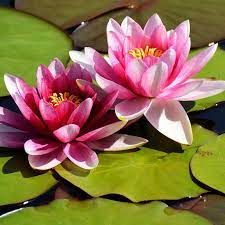
As many times as I have seen spring, it always comes upon me as a surprise. The lengthening days brings with them an amazing explosion of growth. This resurgence of life brings with it the glory of the blooming world. Among flowers is the lotus, admired for both its physical beauty and for its spiritual symbolism. To merely see it evokes the mood of tranquility and serves as an invitation to living in that deeper reality. It is celebrated in the scriptures of Buddhism and Hinduism. While its exact symbolism varies between cultures and religion, those frequently mentioned include purity, strength, divinity, overcoming adversity, and rebirth.
If tranquility is the key to breaking through the difficulties of life into the beauty and meaning of the spiritual, then the example set by this venerable plant provides a clue. Growing in slow-flowing water (ponds, floodplains, river deltas) it has the ability to produce its gorgeous flowers although these waters are swampy, dirty, and unpleasant. This must have resonated deeply with those ancient sages, reminding them that beauty and value may be found even in undesirable places. Its ability to produce stunning flowers in a variety of beautiful colors (each of which has a specific meaning) is contrasted with the mud in which it takes root. The plant establishes its roots in this water-covered soil, sending a long stem upward. Once the bud emerges from the water’s surface, the petals begin to unfold, imparting a delicate fragrance as well as visual beauty. During its life cycle hundreds of seeds are produced. While some germinate quickly, others may lie dormant for years as the weather changes, waiting for the right conditions to appear. This serves to remind us to be patient, and that, as one good thing ends, another may begin. Buddhists admire its ability to emerge from the muddy water without being stained, remaining pure and beautiful. This reminds us to hold our true values true regardless of the conditions which surround us.
So there is the tranquility aspect, but there is also the aspect of transcendence. The power of its symbolism resonates throughout Hindu and Buddhist scriptures, showing the pathway with expressive and poetic language. There is real beauty and depth here. Regardless of our religious affiliation, we can benefit from reflection on these passages. Consideration of the lotus invites us to ascend to the deeper levels of meditation, allowing the flowering of this enhanced consciousness to arise. The writings of the ancient sages attest to this, reflecting their personal thought and experience. They touch upon many aspects of that reality.
One of Buddhism’s key scriptures, the Lotus Sutra, teaches that all beings are capable of full enlightenment. Briefly, the Lotus Sutra is one of the most venerated in Buddhism. Written after the Buddha’s death (as he wrote nothing himself) it contains his final teaching—“complete and sufficient for salvation”. According to American Buddhologist Donald S. Lopez Jr., it presents “a radical re-vision of both the Buddhist path and the person of the Buddha”. Of its teachings, two have been very influential. The first is the doctrine of the One Vehicle, which says all Buddhist practices lead to Buddhahood and are “skillful means” of reaching it. Second is the notion that the lifespan of the Buddha has no end and that he did not really pass on to the final nirvana, but only appeared to do so, and is still active teaching the dharma (the right way of living, the eternal truth). This may appear to be a radical statement, but does not fall far from the teaching of the ever-living Christ whose parting words in Matthew 28:20 were “Lo, I am with you always, even to the end of the age.”, in the Amplified Version, “ Lo, I am with you always [remaining with you perpetually—regardless of circumstance, and on every occasion], even to the end of the age.” For those who may doubt, he continues to make his appearance long after his ascension. (For a more detailed account, see the post I Just Want to See His Face.)
In the West we are familiar with water lilies, but these are not actually lotuses. Botanical differences aside, the appearance of their flowers, coupled with their growth habits, is close enough to convey the desired imagery. Rising from a dark place into beauty and rebirth, it blooms directly out of muddy and murky waters and produce beautiful colored blossoms. What is prominent, as previously mentioned, is that, although it often grows in mud, and returns within it at night, closing its petals as the sun sets, submerging itself under the water to emerge clean and “reborn” each morning. It always blooms clean the following day, evoking the cleansing aspect of spiritual life and the hope it promises. Hindus view the flower as a symbol of one’s ability to capture energy, moving towards divine enlightenment, and that each person possesses the sacred spirit portrayed by the lotus flower. It also represents the transcending of man’s spirit over worldly matter since it blooms from the underworld into the light.
What may even be more remarkable about the lotus is its durability. Its seeds are known to create new plants even under harsh climatic conditions such as being submerged under ice or under extreme heat. While they prefer certain soils, they can thrive under a number of soil conditions. Once mature, some species of lotus can live up to a century.
Many Hindu gods are portrayed either emerging from lotus flowers or sitting on them. This is also true of Jainism, where its founders are pictured sitting on lotus thrones. The ancient Egyptians saw that at night the lotus closed its flowers and sank into the water and opened up in the light hours. They came to associate the flower with rebirth and the sun. It is found in early Vedic texts dating back to 1400 BC. In Hinduism and Buddhism, the lotus flower represents the womb of the universe, where all things are born. For Buddhists, this flower represents enlightenment and the link between the universe’s soul and their own. Hindus have a special connection here, as it has worked its way into the Sanskrit language as the character for enlightenment. Lotus position, or padmasana, is central to the practices of yoga and meditation.
In Buddhist imagery, the lotus’s ability to emerge from murky waters perfectly clean symbolizes purity of speech, body, and mind. Its breaking of the surface every morning is suggestive of the desire for spiritual enlightenment. A main line of thought in Buddhism is that a person’s path in life is similar to that of the lotus. Starting at the seed stage, early in the karmic cycle, continuing to the bud emerging from the dirty water, representing a person following the path of spirituality and leaving attachment behind, and finally blossoming, this is when a person has become fully awakened and has achieved nirvana. In the Buddhist tradition, the lotus flower is associated with Buddha himself. Just as the lotus flower emerges from the mud but remains untouched by it, the Buddha rises pure and untouched by the negative aspects of the world and achieves enlightenment.
Viewing the lotus flower reveals an otherworldly beauty that has the ability to transfix us. Its translucent petals appear to be lit from within, with no hint of the mud in which they are rooted. Its fragrance is sweet and delicate, and floral. The color of its petals ranges from purest white to cream tones to vibrant jewel colors. Each color has a specific meaning. The ancient Egyptians saw that at night the lotus closed its flowers and sank into the water and opened up in the light hours. They came to associate the flower with rebirth and the sun.
The creation account in Genesis has its counterpart in the Hindu scriptures. From the Srimad Bhagavatum: “As the time of creation drew nigh, God felt a stir within his being, and there issued forth from the center of his person a full-blown Lotus. Its luminosity was dazzling, and the whole ocean was lighted by its splendor. Within this Lotus were all the materials for creation. God himself was absorbed within it, and became its innermost being. Immediately Brahma came forth from the Lotus, and, seating himself upon it, turned his head in all directions to see whether any other beings were present….Brahma did not recognize himself, and had no recollection of his previous creations. Thereupon he became restless, and a desire for knowledge rose within his heart. Looking about him and seeing in the external world no hope for the fulfillment of his desires, he sought in meditation for the knowledge which he realized must be within himself, and at last he found the Truth, and God himself, within his own heart. He then saw God everywhere, and felt blest indeed.”
The Srimad Bhagavatum also recalls the Genesis account of God moving upon the waters: “Before the substances appeared as matter, they were in subtle form, And acting together formed an oval structure, which floated upon the water. In that oval structure I dwelt. From the center of my being grew a lotus epitomizing the whole universe, and there the self-born Brahma manifested himself.”
Several more brief selections carry with them the beauty of the lotus-imagery and its potential for our own spiritual growth. Let these wash upon your consciousness to bring a greater awareness:
(Chandogya Upanishad 4:14:3) “As water adheres not to the leaf of a lotus-flower, so evil action adheres not to him who knows this [knowledge of ourselves and knowledge of the Soul (Atman)].” [This is reminiscent of 1John 5:18 “We know that whosever is born of God sinneth not; but he that is begotten of God keepeth himself, and that wicked one toucheth him not.” A further similarity occurs in Praśna 5:5: “As a snake is freed from its skin, even so, verily, is he [who knows this]freed from sin.”]
Yogasattva 9-11 (Reward of the meditation on Om (AUM) “The lotus flower, that occupies The space in the heart, calix down, The stalk on high, dewing down….With the A-sound it become luminous, With the U-sound it opens out, with the M-sound it resounds…..And just as in a crystal perchance is reflected the light of the sun.”
It is only natural that amid the brilliance of the lotus-imagery we find reference to the Divine Person, compared here to the glory of the sun. In the words of the Savitri Hymn: “In the morning he worships the sun, and says: ‘Of the quarters of heaven thou art the lotus-flower! [translator Robert Ernest Hume’s note: “A symbolic expression for ‘pre-eminent.”] May I of men become the one lotus-flower!’ ” The Divine Person is further revealed and described in the Chandogya Upanishad 1:6:6-7: “….Now, that golden Person who is seen within the sun has a golden beard and golden hair. He is exceedingly brilliant, all, even to the fingernail tips. His eyes are even as a Rapayasa lotus-flower. His name is High (ud). He is raised high above all evils. Verily, he who knows this rises high above all evils.” [compare to the attribute of high ascribed to the name and person of God and Christ]
(Narayana Sooktam) “The Heart [a term involving consciousness, encompassing more than just the physical organ] , the perfect seat of meditation, resembles an inverted lotus bud. In the region below the throat and above the navel there burns a fire from which flames are rising up. That is the great support and foundation of the Universe. It always hangs down from the arteries like a lotus bud. In the middle of it there is a tiny orfice in which all are firmly supported.”
Sanskrit terms and their commentaries extend to their own descriptions of physiology. These scriptures speak of the Sahasara, a thousand-spoked cavity found in the head, said to resemble a lotus in reversed position: (Paramhansa Yogananda) “ a thousand-rayed lotus of life and light in the brain, which shines like a thousand suns in its power and glory.”; (Bede Griffiths) “Finally, there is the thousand-petalled lotus, the Sahasrara, at the crown of the head. All these energies come to a head in this lotus which opens on the Divine Light. This is where the whole person comes to flower, as it were, and reaches perfection. The Virgin Mary is depicted in India as seated on a lotus like the Prajna paramika, the supreme perfect wisdom in Mahayana Buddhism. She is the mother in whom divine wisdom, which in India is conceived as the Divine Mother, comes to flower. [The Hindu goddess of wisdom, Sarasvati, is similarly pictured as seated on a lotus symbolizing the purity of truth which dwells in the center of life and opens its beauty to the light.]
These ancient visions carry with them the ring of truth. They cross traditions and, in so doing, have the authenticity of a shared experience, as they illustrate the pathway to the Divine. May they enliven your thoughts and inspire you to participation in what is deeper and greater.
 Divinepersonhood