“You heard the sound of words but no shape, only a voice”. —Deuteronomy 4:12 (Jerusalem Bible)
Principal Judeo-Christian verses are from the Jerusalem Bible, to which I am indebted for its wealth of explanatory notes. Additional references appear to the King James Version (KJV), Revised Standard Version (RSV), and New English Bible (NEB). Jerusalem Bible notes,here as “notes”, are cited for their wealth of background information. KJV, RSV, and NEB verses, and their notes, are identified when included.
This post is presented in two parts because of its length. Part II will follow soon. I trust that your persistence will be rewarded by the fascinating path of this universal mystery as it unfolds in the scriptures and in history.
Some of what is here has been visited before in Weird Scenes in the Desert. Here the emphasis is on the supreme self-assertion of the Name (=person) of God, I AM, revealed to Moses and the prophets, continuing to Part II (The Kingdom of Our Lord) with its essential transformation in the personhood of Christ. The great “I AM” is a wonderful mystery validated by its existence in traditions other than the Judeo-Christian alone. The name of God, and the ways in which we may approach the Divine Person, is as important to us as it was to those ancient sages. The universal presence of I AM in other scriptures only adds to its authenticity and relevance.
In my preparation I went back in time to the archives of Pacific Institute of Religion. There, in a 1935 thesis by someone I knew well, Rev. Milton G. Gabrielson, lay a summation of Divine Personhood, progressive for its time. As I read through his thesis, I realized that it could have served as an introduction to this website. His surprisingly modern approach to theological thought was characterized his ensuing ministry of nearly 35 years. I will quote from the introduction:
“We are beginning to realize personality as the soul of things, as the one reason for things. Religion has reached us through the great personalities. Christianity is a religion of personalities; and it holds its place as having in its Founder the deepest rooted of all the souls we know; the one whose character, teachings, and works reach farthest and highest, “our divinest symbol’ as Carlyle has it, the incarnation of all that is to us dearest and holiest. But current inquiries are raising the question: Can the character of God be ascertained merely by learning the character of Jesus?—which is the theological way of saying: Can the character of cosmic reality be deciphered in terms of personality? Certain modern writers are replying to this challenge with a single, characteristic assertion: ‘Jesus in the highest we know, therefore we must interpret God in terms of Christ.’ When we affirm personality of God we do not mean the pictured patriarch of the Dore Bible Gallery but of a power, self-conscious, intelligent, and self-directing upon which all the forces of nature momentarily depend, acting through these forces in an intelligent way. This supreme intelligence upholds and maintains the whole order of relations, not having once created the world but momentarily creating it. Since this source and ground of all things is both purposive and intelligent, what the normal intelligence of man perceives is true.”
To appreciate the importance of this consideration, we must go back much further than the Judeo-Christian tradition alone. This underlying foundation serves to validate its universal relevance and gives us additional insight. The sages who composed the Sanskrit scriptures must have been on to something, for this language contains a wealth of terms which provide a roadmap to spiritual consciousness which both underlies and expands that of the Judeo-Christian tradition. They point to the very One that those of many ages seek. Juan Mascaró, the esteemed translator of the Upanishads, Bhagavad Gita, and others, provides the context in which the scriptures of these two traditions may be viewed: “Micah [by inference the Judeo-Christian scriptures] did not give us the metaphysics of an inner sacrifice as the Upanishads do. They give us our inner I AM who is ours and not ours, because it is the I AM of all, the I AM of the universe. According to Coleridge, the higher imagination is ‘the repetition in the finite mind of the eternal act of creation in the infinite I AM.’ This idea might lead to the Upanishads: the Infinite is ever in us and the finite in us can have communion with the infinite.”
To begin, AdhyamPurusham is the cosmic Person of the Rig Veda who is an archetype of the whole universe. From him flows the energy or the primordial power which is called pravritti; The return journey is nivritti, going back through the senses and the mind and returning to the One. This leads us to Aham, the absolute I, with its affirmation Aham Brahmasmi, ahambrahmasmi: “I am the Absolute (Brahman). Wikipedia says the literal meaning is that of the ”I” that cannot be deserted or abandoned since it is constant, unavoidable, ever present. Brahman means ever-full or whole. Asmi means ”am”. Ramon Pannikar lends a Christian interpretation: “Insofar as we are one with Christ, we are one with the Father. Although I am not the Source, the Source is neither separated nor separable from me. I would like to stress that man’s dignity lies precisely in his being conscious of the fact that he and the Father are one.” Yogananda explains further: “ ‘I am He’, used by Jesus is “a declaration of ultimate truth that has similarly been ecstatically realized and uttered by master minds of India who lived before and after the time of Jesus. The Isha Upanishad says: ‘That absolute Self abiding in the transcendental effulgence, verily, I am He.’ ”
There is a compelling argument that “I Am” in the form of AUM, OM, Amen, or Amin may be added to the traditional Judaic “names of God”, Tetragrammaton, Adonai, El, Elohim, Shaddai, Tzetaot. Jah should be considered for inclusion as well. It is a key which allows our approach to the divine.
Mascaró provides the origin of the great I AM which closely follows that of Genesis in his translation of Rig Veda 7:86: “There was neither death nor immortality then. No signs were there of night or day. The ONE was breathing by its own power, in deep peace. Only the ONE was: there was nothing beyond. Darkness was hidden in darkness. The all was fluid and formless. Therein, in the void, by the fire of fervour [British spelling] arose the ONE. And in the ONE arose love. Love, the first seed of soul. The hearts with wisdom, the sages found that bond of union between being and non-being.”
John Grimes, in his Concise Dictionary of Sanskrit Philosophy, links the great I AM to Iśvara, the Lord,and its related terms: “The consciousness of Iśvarais ‘This am I.’…. usually the Lord, but also the Lord who dwells in the individual soul which transmigrates at death; the equivalent of Sat, cosmic ruler, Supreme Pure [śuddha] Essence of cosmic consciousness, the transcendental intelligence; the Lord of the Universe, the personal God as creator; symbolized by pranava, the holy word or sound, Aum.”
With this foundation we continue. The Hebrew “I Am that I Am” is the first of three responses given to Moses when he asks for God’s name (Exodus3:14). In the Talmud, Ehyeh is the first-person singular imperfect form of hayah, “to be”. So, the usual translation here is “I will be”, using the imperfect tense in Hebrew since the actions that are not yet completed. Although Ehyeh asher ehyeh is generally rendered in English “I am that I am”, better renderings might be “I will be what I will be” or “I will be who I will be”, or “I shall prove to be whatsoever I shall prove to be”, “I will be because I will be”, or “I Will Become whatsoever I please.” Finally, there is the Greek, Ego eimi ho on, “I am The Being” or “I am The Existing One”, and the Latin ego sum qui sum, “I am Who I am.”
The “name” is a direct reference to the “person” of the God and, in messianic history, of Jesus. For this reason it should not taken lightly. This does not mean that the Divine Person is unapproachable, in fact the opposite. Here is a beautiful quote from the classic devotional booklet Quiet Time:“That God actually desires our fellowship is, perhaps, one of the most amazing facts conveyed to us through the Scriptures.” This is epitomized in the story of Moses, the “friend of God”, who would converse with him (Exodus 33:11) “face to face, as a man speaketh to his friend” (KJV). We attract the presence of God by quiet meditation. Psalms 46:10 reads, “Pause a while and know that I am God”.
There is the curious case of the “angel of the Lord”. Numerous accounts of these visitations exist. In some instances it is God himself, in others a messenger angel, in others we may not be certain. In the event titled “the apparition at Mamre”, Abraham (then called Abram) is visited by three angels appearing as men. Some commentators interpret this as being a foreshadowing of the doctrine of the Trinity, and by others as a pre-incarnate appearance of Christ. Abram then builds an altar, invoking the name of Yahweh. The scripture reads that, at Yahweh’s direction, Abram’s name is changed to Abraham, meaning “father of a multitude”.
Hagar was the Egyptian slave girl given by Sarah to Abraham to bear him a child. Tension between the two women arose after Hagar became pregnant. Her mistreatment by Sarah caused her to flee to the desert. There the “angel of Yahweh” appears. The notes differentiate between a created being distinct from God and God himself, and state that this is a direct theophany, not the appearance of an intermediary (i.e., where God “will now send his angel ahead of you”). Hagar utters this beautiful exclamation, “Surely this is the place where I, in my turn, have seen the one who sees me”, a truly miraculous occurrence. She gives God the name El-Roy [KJV notes: “That is, God shall hear.”; “That is, the well of him that liveth and seeth me.”; RSV notes: “Have I even seen after him who sees me?’ “; NEB notes “She called the LORD who was speaking to her by the name El-Roy, for she said Have I indeed seen God and still live after that vision.”. She then calls the well where her vision occurred Beer Lahai Roi [NEB notes: “That is God heard.”; “That is God of vision”; That is the Well of the Living One of Vision.”; RSV notes: “That is, the well of the one who sees and lives.”] The well is still there today, between Kadesh and Bered.
We move on to the well-known story of Jacob’s wrestling match with God. Here Jacob prevails against God (in the form of an angel) and will not let him go unless he is blessed. Furthermore, he implores God to tell him his name. Although this does not occur, God blesses him. Recalling that to look upon God is to incur death, this is an amazing event indeed. Thus, a special privilege has been granted and, as in the case of Abraham, a name change occurs. Jacob is now known as Israel, and the place called Peniel, “because I have seen God face to face” [KJV notes: “That is, the face of God (Peniel)”; RSV notes: “That is, he who strives with God or
God strives (Israel)”; NEB notes: “God strove”]
Probably the first messianic indication we encounter is the cryptic passage in Genesis 49:10-12. While the reference of the scepter passing “to whom it belongs” is most likely to David, it probably refers to David as a type of the Messiah as understood by Jewish and Christian tradition. This is a recurring theme throughout the scriptures.
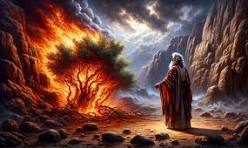
Exodus 3:1-6 brings us the first mention of God’s appearances to Moses, the most intimate to date in the appearances of God. In this, the “theophany of the bush”, the bush, while burning, is not consumed by the fire, and God calls out. Moses answers “Here I am”, and is told to come no further, for the place upon which he is standing is holy ground. He covers his face, afraid to look upon God. Here, the “angel of Yahweh” is identified by the notes as God himself, as in the appearance to Hagar.
Later in Exodus (24:16-18) Moses goes right up the mountain and into the cloud. The fire and the cloud, associated with the mountain, whether geologic or spiritual, are images borrowed from other biblical accounts of God’s glory. It should be noted that in Ezekiel this “glory” assumes a shining, human form.
Exodus 33:7-17 (KJV title: Moses prays for God’s presence”) tells us how “Yahweh would speak with Moses face to face, as a man speaks with his friend”, and in verse 12 assures him, “I know you by name and you have won my favor.” What a high honor to be known as a friend of God. In verse 15, Moses passionately implores God, (KJV) “If thy presence go not with me, carry us not up hence.” Separation from God, then, would be the failure of Moses’ call to achieve unity with God for himself and his people.
As a result of his encounter with God, in Exodus 34:35, “the skin of Moses’ face shone”. Although he was not aware of it, Aaron and all the sons of Israel saw that the skin on his face “shone so much that they would not venture near him” (34:30). His brilliance was such that he needed to put a veil over his face when speaking to them, “the people, removing it only when he went again into Yahweh’s presence to speak with him. The light on the face of Moses, it appears, was none other than the light of God. The glow on the Christian martyr Stephen’s face appeared to onlookers as “the face of an angel” in his transfiguration (Acts 6:15). His ecstatic state continued even as he was stoned for his testimony. where he sees “the Son of Man standing at the right hand of God” (Acts 7:55-56). This state is supported by Psalms 34:5, where “every face turned to him grows brighter”. This alludes to the glow on Moses’ face and prefigures the later Transfiguration of Jesus. The face of God is mentioned as well. We are implored in Psalms 105:1-4 (KJV, JB) “seek his face”; (RSV, NEB) “seek his presence”]
We know of and may have even seen the glow on the faces of those who have an ecstatic relationship with the Divine. Perhaps some of us have experienced it ourselves. A disciple of Swami Ramakrishna was so transfigured that “a light emanated from his whole body” and was so evident that “crowds of people…fell back in amazement and made way as the illumined holy man walked in complete absorption in the thought of God.” (Swami Prabhavananda, The Sermon on the Mount According to Vedanta). Psalm 4:6 invokes God to “Show us [literally, “lift up”] the light of your face, turned toward us!” JB notes indicate that the several subsequent verses affirm that this is what makes the Christian “a child of the light”. Not only is our face shining, Psalms 31:16 say that God is smiling: “Let your face smile on your servant.” Psalms 80:3 reads, “let your face smile on us and we shall be safe”. Shining and smiling, this is the nature of a loving, compassionate God.
Relationship to the Name or person of God is invoked in the words from Deuteronomy. 6:4-9 inscribed on a scroll posted by the door of devout Jews (and others) called the Mezuzah, We are to “write the words (loving God with all our heart, soul, and strength) on our hearts”. (see the post, My Mezuzah). It is worth repeating its declaration of faith: (KJV) “Hear, O Israel: The LORD our God is one LORD: And thou shalt love the LORD thy God with all thine heart, and with all thy soul, and with all thy might. And these words, which I command thee this day, shall be in thine heart: And thou shalt teach them diligently unto thy children, and shalt talk of them when thou sittest in thine house, and when thou walkest by the way, and when thou liest down, and when thou risest up. And thou shalt bind them for a sign upon thine hand, and they shall be as frontlets between thine eyes. And thou shalt write them upon the posts of thy house, and on thy gates.”
In Leviticus 16:2, the “throne of mercy”, where Yahweh dwells above the ark, is “beyond the veil”. Here he appears in a cloud but, as in God’s appearance on the mountain, to approach him is to risk death. Moses is told that Aaron is not to enter the sanctuary beyond the veil or he may die. The veil assumes great importance in later passages, notably the tearing of the temple veil in two following the crucifixion. Concerning the veil of the Temple, Hebrews 6:18-20 concludes with Christ “reaching right through the veil, to become a high priest of the order of Melchizedek, and for ever.” There is also the veil with which Moses covered his face when speaking to the people after his encounters with Yahweh, hiding his brightness, Finally, veiling explains the way in which the glory which Christ shared with his Father was hidden when he assumed human form.
Leviticus 19:1-4 carries with it the demand for holiness, “Be holy, for I, Yahweh your God, am holy. This affirmation is echoed in 1 Samuel 2:2 “There is none as holy as Yahweh.” We are then admonished, “Do not turn to idols”. This means far more than graven images, including the vain pursuits of the world. The notes clarify these as “literally, things of nothing”.
Throughout the Old Testament, references abound to the phrases (JB) “call down my name”, (NEB) “pronounce my name”, “bear the name of Yahweh” (or “bear my name”), “fear the name”, “stand in awe”. As in Exodus, there are several accounts of the glory of Yahweh manifested in physical phenomena: the cloud by day and the pillar of fire by night, the voice speaking from the heart of the fire, and others. In 1 Kings 8:12 Solomon exclaims, “Yahweh has chosen to dwell in the thick cloud.” In 1Chronicles 16:10 we are told to “glory in his holy name”, and that the hearts that seek Yahweh will rejoice.
Numbers 24:15-17 is another foretaste of the Messianic age to follow. Here is an image we know well, that of the star, which in the notes “seems to refer to the Davidic dynasty from which the Messiah was to come”.
Deuteronomy provides a window through which we can view additional aspects of God. 4:7 emphasizes God’s nearness to man as in Exodus 33:20, contrasted with other traditions which emphasize the distance between God and man. 4:12 adds the manifestation of an audible voice: “you heard the sound of words but no shape, only a voice”. In 4:24, “Yahweh your God is a consuming fire, a jealous God.” In the notes, ‘God’s “jealousy” is the extravagance of his love”, cited in several additional passages. 4:33-40 again mentions the voice of God speaking from the heart of the fire, “as you heard it, and you remain alive”. The hearing of a voice continues in further manifestations in the time of Jesus, detailed in Part II.
In Joshua 5:13-15, Joshua is told by Yahweh to “take his sandals off your feet, for the place he is standing on is holy”. Today we recall this event when we invoke God’s presence in the well-known hymn, “This is holy ground, we’re standing on holy ground, for the Lord is here and where he is, is holy”.
In several accounts there is confusion as to whether an appearance is that of God himself or an angel. They alternate throughout the scriptural record. In Judges 6:11-16, the notes indicate that it is Yahweh himself. This inference is supported by other verses, but an exception occurs in verse 22, where the text reads “Yahweh and his angel”. The confusion is understandable. We get some clarity in the apocryphal book of Tobit 5:5, where Raphael the angel appears. The notes provide the explanation that, here, the angel is a creature distinct from God: “With the exception of the ‘angel of Yahweh’ or ‘the angel of God’, which in the earliest texts are phrases used to express the visible manifestation of God…the angels are creatures distinct from God, members of his heavenly court, called ‘sons of God’, ‘sons of heaven’, ‘holy ones’, ‘host of heaven’….Some are destroying angels, others guardian angels, either of nations or of individuals.”
Psalms 2:7 (JB passage title: “The messianic drama”) takes a great leap forward to state what will appear later Revelation 11:15: “The kingdom of this world has become the kingdom of our Lord and his Christ, and he will reign for ever and ever”. It contains what is described as “Yahweh’s decree”: “You are my son, today I have become your father.” The drama unfolds as it passes from the Old Testament to the New. This leap, as adventurous as it may be, is identified as such by James Gilchrist Lawson in his edition of the KJV. He titles this psalm “The kingdom of the Son”
The adoration of the Divine Person in Psalms 118:27 is cited in the scriptures for the triumphal procession of Palm Sunday 118:27: “With branches in your hands draw up in procession as far as the horns of the altar.” This ritual is known as lulah, where branches of myrtle or palm are waved as the procession circles the altar.
The book of Isaiah is full of its characteristic awesome and fearful imagery of God. The manifestation of Yahweh (or his angels) in 2:10 can, of course, invoke fear and terror. Were not the shepherds, too, “sore afraid” when visited by the angels at Jesus’ birth? A visitation from the Divine is awesome indeed. 6:1-4 contains the legendary account of the glory of the Lord Yahweh filling the sanctuary with burning smoke, along with seraphs, heavenly beings whose name means “burning ones”. 7:14-15 strongly announces the coming of the Messiah and identifies him as Immanuel, that is God with us, the presence of God in human form. In 9:6-7 the description “Prince-of-Peace” is introduced, along with his dominion “for the throne of David”.
Isaiah 40:18 points to the transcendence of God, incomparable, absolute, beyond what we can think: “To whom could you liken God? What image could you contrive of him?” Verses 25 and 26 further develop the theme. A further description occurs in 41:4 “the first and shall be with the last”, in other words, eternal. “The first and the last”, “no other God beside me” [in this instance capitalized] is repeated in 44:6-8, whose JB title is “Monotheism without compromise”. The unrivaled supremacy of Yahweh, “unrivalled”, “no god beside me” [in this instance uncapitalized, denoting the lesser gods] is continued in chapters 45 and 46.
In the first song of the servant of Yahweh, Isaiah 42:1-4 (JB title: “Yahweh alone is God”), he who serves and represents Yahweh is endowed with his spirit and who, through suffering, will bring salvation to all, among other descriptions. The importance of this passage is underscored by the extensive commentary it has inspired among biblical scholars. The continuity of the prophetic calling is addressed: “He does not break the crushed reed [RSV “bruised”] is a messianic reference to one beset by human frailty as he comes among us, as the incarnation of Jesus certainly was.
Chapters 43-46 contain some amazing spiritual affirmations, of which I will list a few: In 43:7 “all those who bear my name, whom I have created for my glory, whom I have formed, whom I have made” God glories in those formed in his image. 45:8, “Let deliverance bud forth” is an evocative phrase, using the metaphor of growth and development—and more than that: it is a messianic title repeated in several Old Testament passages, as the notes state, “a messianic prince with a branch from the Davidic stock” (explored in the post The Root of David and the Branch). In 45:15 “Truly, God is hidden with you” speaks of the “still, small voice” of God which must be discerned through humble devotion in order to reveal itself. 45:19 contains a curious passage, “seek me in chaos”. The notes explain that this is “the universe as it was before God imposed order on it”, recalling Genesis 1:2 “Now the earth was a formless void”. In 45:21-25 (JB title: “Yahweh is God of all”) “Turn to me and be saved…for I am God unrivaled” the notes read
“The wide sweep of messianic hope has never been more clearly expressed than in this oracle.” Finally, in 46:8-10 (JB title: “Yahweh is lord of the future”) God is beyond time, as he has created it: “From the beginning I foretold the future, and predicted beforehand what is to be.”
Isaiah 60:1-7, “arise, shine out, your light has come” may be interpreted as a prophecy of the light of Christ coming into the world. The notes state that the liturgy applies verse 6, where “everyone in Sheba will come, bringing gold and incense” to the visit of the Magi and connects this to the previous passages suggesting a messianic intent.
As the book of Isaiah concludes, emphasis is given in 63:19 to the importance of the name of God. When the Israelites stumbled, they were “like people you do not rule, people who do not bear your name.” This is carried forward by the prophet Jeremiah, in 14:8-9, which plaintively asks “why are you like a stranger in this land, like a traveler who stays only for a night? “We are called by your name” (in other versions “thy name is called upon us”) is concluded with the plea, “Do not desert us!
Coming from an era where idolatry in Judaism and other traditions was practiced, Yahweh asks in Jeremiah 16:19, “Can man make his own gods? If so, these are not gods!”, giving the answer in verse 21 that he will “make the acknowledge my hand and my might; and they will know that Yahweh is my name.”
In Jeremiah 23:5-6 The Yahweh-messiah connection is announced: “The days are coming… when I will raise up a virtuous Branch [abundantly used as a messianic term] for David….And this is the name he will be called: Yahweh-our-integrity.” Anticipating the “Prince of Peace” title of Jesus, Yahweh is identified in Jeremiah 50:34 as a strong redeemer, bringing peacefulness to the world, “but trembling to the inhabitants of Babylon.”
The book of Ezekiel contains fantastic manifestations of God’s power exhibited on the physical plane. In 3:12-14, Ezekiel is lifted up by the spirit and behind him he hears “a tumultuous shouting, ‘Blessed by the glory of Yahweh in his dwelling place’. The source of this sound, we are told, is “the animals’ wings beating against each other, and the sound of the wheels beside them”. There are interpretations, but I will not go into them here.
From here, warnings proceed. 6:6-7 warns that towns will be destroyed, high places wrecked, idols will be abolished, incense burners will be smashed, concluding with “the utter destruction of your works”. Why? “So you will learn that I am Yahweh” [a recurring theme in Ezekiel]. At length Yahweh promises in 16:62-63 that he will renew his covenant, but this will not be a joyous occasion, for with this pardon the inhabitants will be “covered in shame” and “reduced to silence” when they have been pardoned for all they have done. Is this not a fitting condition when we confess our sins to God? It is if we are truly repentant. An interesting commentary appears in the JB notes to 20:9: “The sole reason for Yahweh’s forbearance with his people, despite their apostasy, is the honour [British spelling] of his name.”
All of this, however, is not without mention of the compassionate nature of God’s presence when in Ezekiel 20:41: “I will welcome you like an appeasing fragrance when I bring you out from among the peoples; I mean to gather you from the foreign countries in which you have been scattered”. Verse 44 continues in this vein: “Then you will learn that I am Yahweh, when I treat you as respect for my own name requires, and not as your wicked behaviour [British spelling] and corrupt actions deserve….”
Another foretaste of the messianic era appears in 29:21 when Yahweh declares that he will “cause the House of Israel to sprout a horn”. A horn, as the notes explain is “a symbol of power, sometimes of messianic significance…” It is a common theme in scripture, and is made more explicit in Psalms 132:17: “Here I will make a horn sprout for David, here I will trim a lamp for my anointed, whose enemies I shall clothe in shame, while his [my] crown bursts into flower.” 36:21-28 gives us a foretaste of the messianic kingdom, which is an expression of Yahweh’s being “concerned about my holy name”, profaned by the House of Israel. What will come is meant to “display the holiness of my great name”. As a result, “I will pour clean water over you and you will be cleansed….I shall give you a new heart, and put a new spirit in you”. This is the power of the name, continuing “You shall be my people and I will be your God.”
As the book of Ezekiel concludes in chapter 43:1-9, the manifestation of the person of Yahweh with the power of teleportation returns once more. Ezekiel is taken to the east-facing gate to see the glory of God approaching. This vision is consistent with that of his departure. Ezekiel prostrates himself, at which point he is lifted by the spirit and brought to the inner court, “the dais of my throne, the step on which I rest my feet”. Here God promises, “I will live among the sons of Israel for ever”. Could this be a foretaste of Immanuel, God with us?
Daniel 7:13-14 introduces the vision of “one like a son of man”, coming on the clouds, on whom “was conferred sovereignty, glory and kingship”. This vision will reappear in Revelation 1:12-16. The notes ascribe this most particularly to Jesus, who applies it to himself cryptically in Matthew 8:20: “Foxes have holes and the birds have nests, but the Son of Man has nowhere to lay his head.”). So, the foretaste of the messianic drama continues.
Joel 2:28-32 (alternate versification 3:2-5) contains a wonderful promise: that Yahweh will pour out his spirit [or in the Greek translation “a portion of my spirit”] on all mankind [note the universal emphasis], accompanied by dreams, visions, and astral events [sun into darkness, moon into blood, suggesting an eclipse], concluding in the final verse, “All who call on the name of Yahweh will be saved.” This universality is a mark of the coming age.
Micah 4:3 contains its well-known prophecy of peace, “they will hammer their swords into plowshares”. Notably, this is preceded by the condition that Yahweh “will wield authority”, thus establishing the condition under which this will take place. The remnant of Israel, in Zephaniah 3:11-13 will be left as “a humble and lowly people” who “will seek refuge in the name of Yahweh”. Humility is a key element and is the pattern for all generations, ours included, to follow.
One of the famous “stone” references appears in Zechariah 3:9, “a single stone with seven eyes” [signifying, as the notes state, the watchful presence of Yahweh], with an inscription cut upon it by Yahweh himself. In New Testament passages the stone, of course, describes Jesus. Verse 3:8 identifies the servant of Yahweh ask the “Branch”, a messianic title. The Branch references continue in 6:12-13, where there will be “a branching out” [KJV “he shall grow up out of his place”] as the Messiah rebuilds the sanctuary of Yahweh and wears the royal insignia. This sacred place, set apart from the profane, has been interpreted in both its external and internal aspects. We can call upon God’s name in either. In 14:10, in the “Day of Yahweh”, his name will be unique. How could it be otherwise? 14:9 announces the triumph of Yahweh, who “will be unique, and his name unique” when his day comes.
As a final look into the essential transformation to come, Malechi 1:11 describes a “pure offering”. The notes read that, this is “the perfect sacrifice of the messianic age”, not “the widespread cult in the Persian empire” of the “God of Heaven”, a pagan form of worship mentioned in Nehemia 1:4. The Old Testament concludes with the messianic prophecy of the New in 3:20 [JB, in other versions 4:2]. We know it in the Christmas hymn “Hark, the Herald Angels Sing”, “hail the sun of righteousness, risen with healing in his wings” (KJV, RSV). The JB passage reads “But for you that fear my name, the sun of righteousness will shine out with healing in its rays.” John the Baptist is prophesied here too, in 3:23 [4:5], identified as Elijah, taken up to heaven, who will return. Jesus was later to explain that Elijah had indeed come in the person of John. I will not address the possibility of reincarnation here—it will appear in part 2. And so the stage is set for the New Testament and its fulfillment of what has been preceded it.
To be continued in Part II, The Kingdom of Our Lord, to be published later.

 Divinepersonhood