
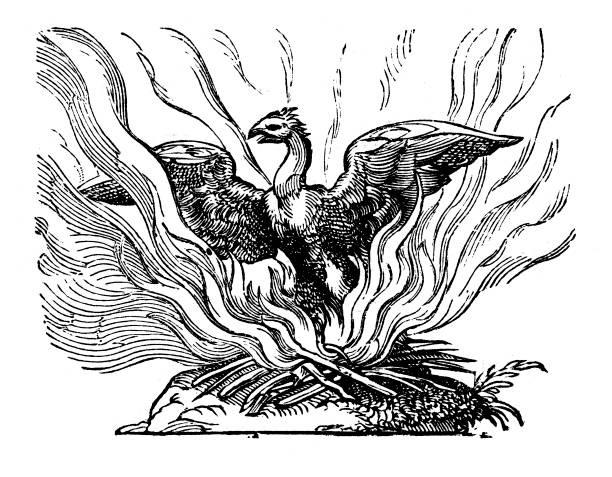
This post comes to you in the Season of Easter, and for a reason. The image of the venerable Phoenix has connections within and beyond the Christian faith. For this reason it is unusually powerful among mythological symbols. It is directly involved with the dynamics of human life due to its dual qualities of creation and destruction. As such it mirrors the realities of human consciousness. There is its “descending aspect”, the tendencies leading to the downfall of people, ideas, and movements which have sown the seeds of their own destruction. But, true to its nature, this need not be final, for it is balanced by an “ascending aspect” as that which was destroyed rises from the ashes to new life. This includes resurrection as an historical event, or more generally, as the universal impulse leading from death to life. The realm of nature recovers from destruction. New societies are formed. Human consciousness is renewed as powerful forces once more arise.
Phoenix-power is evident in the imperfect history of our American “experiment of democracy”. Here religious, cultural, and racial minorities have struggled against the forces of prejudice, persecution, even death to achieve their rightful status and respect. It is a continuing struggle whose tasks are always before us and is never truly finished. The dynamics of Phoenix-life are constantly in play, giving this living symbol its power.
The Phoenix and I go back a long way. For many years I taught at Salinas Adult School, whose mascot was the Phoenix. This was appropriate, for many of our students overcame the circumstances of their lives to become successful learners, job holders, parents, and U.S. citizens. We had a Phoenix costume which could be worn for school and community events. In my latent buffoonery, I volunteered to wear it, so being the bird became my official function.
The descending aspect of the Phoenix, as stated, can be individual or societal. Individuals sow the seeds of their own downfall. These destructive tendencies extend to groups. Christianity has historically been plagued by departures from the original, ecstatic core which motivated its early devotees and led to its growth. The current predicament is nothing new. As this is written, a sizeable portion of those who call themselves evangelicals support a militarization of the faith. One pastor has even adopted military fatigues and combat boots as his clerical garb. They seek a so-called Christian nation, contrary to the Establishment Clause of the First Amendment which prohibits the favoring of one religion over another to ensure a separation of church and state. Books are banned. History is revised and even erased. Racism, dressed in the guise of eliminating diversity, equality, and inclusion, seems to be back in style (not that it ever went away). Immigrants are scapegoated and persecuted (the “Great Replacement theory”) despite the teachings of Jesus and the “humane legislation” of the Old Testament prophets. How else would you interpret “Do not mistreat the stranger living in your land, but treat him just as you treat the native among you. Love strangers as you love yourselves, because you were strangers once in the land of Egypt (Leviticus 19:33-34)?”.Racism and religious discrimination comes into play. Population of detention centers swell as legal residents, citizens, even children are “disappeared” without due process, resembling the gulags of the former Soviet Union. The role of women, including voting rights, is proposed. War against other nations is encouraged, despite blatant violations of international law. Some are crowing at the death and violence in the Middle East, claiming it is a sign of the end times and the return of Jesus. This sorry state of affairs was predicted by the late senator and presidential candidate Barry Goldwater in a prophetic statement many years ago. His words have the ring of truth: “Mark my word, if and when these preachers get control of the [Republican] party, and they’re sure trying to do so, it’s going to be a terrible damn problem. Frankly, these people frighten me. Politics and governing require compromise. But these Christians believe they are acting in the name of God, so they can’t and won’t compromise. I know, I’ve tried to deal with them.”
Equally dismaying is an opposite segment of Christianity which worships at the altar of demystification. In the course of so doing these adherents drain away its spiritual power and wonder. Once led by the notorious Jesus Seminar, criticized as “the search for the irrelevant Jesus”, its dry scholasticism more resembles a book club than a living faith. In the Easter season we are offered chickens, bunnies, and eggs as a pale substitute to the empty tomb. Wonder, glory, and power are replaced by what might be seen on a secular greeting card.
Here is a brief analysis by Dr. Julian Keiser of the current dilemma: “The fundamentalist churches tend to bury the event in a divine legal transaction to secure salvation through the blood of Christ to atone for men’s sins (usually thought of in pietistic, moralistic terms). The liberal churches tend to avoid the event altogether by placing their emphasis on Triumphant Palm Sunday, the fellowship of the Last Supper and the immortality of Easter, with scarcely a nod to Black Friday (sweetened by calling it Good Friday).” And the antidote: “The renewal of the Christian Church, however, seems to be centering on those who fix their attention on such true disciples as [Dietrich] Bonhoeffer, who like His Christ, suffered and died in loyalty to the divine truth at the hands of the political powers, aided by the silence and apathy of the religious leaders who were too timid to be faithful to their God. They rationalized away the relevance of their faith to the social and political (corporate) sins of men which continually crucify Christ.” And so, the original core of Christian faith founded in the joy of the Resurrection is sacrificed by both extremes who have departed from it.
But return is possible, in fact, inevitable. The Phoenix’s ascending aspect holds promise for Christianity, for America, for the world. Like yin and yang, one aspect stimulates the opposite, holding the latent ability to rise from the ashes of destruction and hardship to start anew. Its key qualities are:
- Rebirth andResurrection, like that of Christianity itself, involves the Phoenix dying by fire and being born again, symbolizing triumph over death and adversity.
- Transformation and Resilience which turns painful endings into new beginnings, with hope which springs anew, the indestructible spirit of humanity.
- The Sun and Time mirrors ancient Egyptian and Greek mythology, linking the Phoenix to the sun—dying at night and rising in the morning, embodying the solar cycle. (For a fuller appreciation see the posts “Start with the Sun” and “Stay with the Sun”.)
- Hope and Renewal,reminding us that destruction is not the end and that hope can arise even in our darkest moments.
- Healing and Purity, where insome traditions the Phoenix’s tears are believed to have healing properties.
More about origins: The Phoenix was known in Ancient Egypt as the Bennu bird, associated with the creation myth and the sun. Early Christians used it to represent the resurrection of Christ and the immortality of the soul. In Chinese mythology the Fenghuang (or “Chinese Phoenix”) represents the union of yin and yang, symbolizing harmony and virtue. And so it continues to be a powerful modern symbol for overcoming crisis and for personal and societal transformation.
No matter the darkness of our current (or any) age. The Phoenix carries within it hope and power. Hail to the Bird of New Beginnings and its power to rescue us from destruction to wonder!
 Divinepersonhood